
Patients Who Arrive After Hours Still Get Seen
A patient who arrives at 10 p.m. doesn't hit a closed door. Asynchronous workflows keep them moving until a provider picks the case up, instead of asking them to come back tomorrow.
White labeled telehealth software
Run a complete telehealth service under your own brand — your site, your booking flow, your records system, your patient relationship. Synchronous video or asynchronous review, whichever the treatment and the state call for. The licensed provider network comes with the platform, so there is nobody to recruit and nothing to staff.
Launch in about ten minutes. Pay $27.99 per completed consultation.
No sign-up fee · No subscription · No annual contract · Cancel anytime
Licensed provider coverage in 48 states + D.C. · LegitScript certified
Definitions
Most vendors call themselves white label when they can put your logo in a corner. That is skinning, not white labeling. Your brand has to hold at four separate points for the patient never to learn our name.
Visit modes
Some encounters need a live conversation. Others don't, and forcing one costs you bookings after hours. Qualiphy supports both modes under the same branding, the same provider network and the same record — and the choice is configured per encounter type, not fought over per patient.
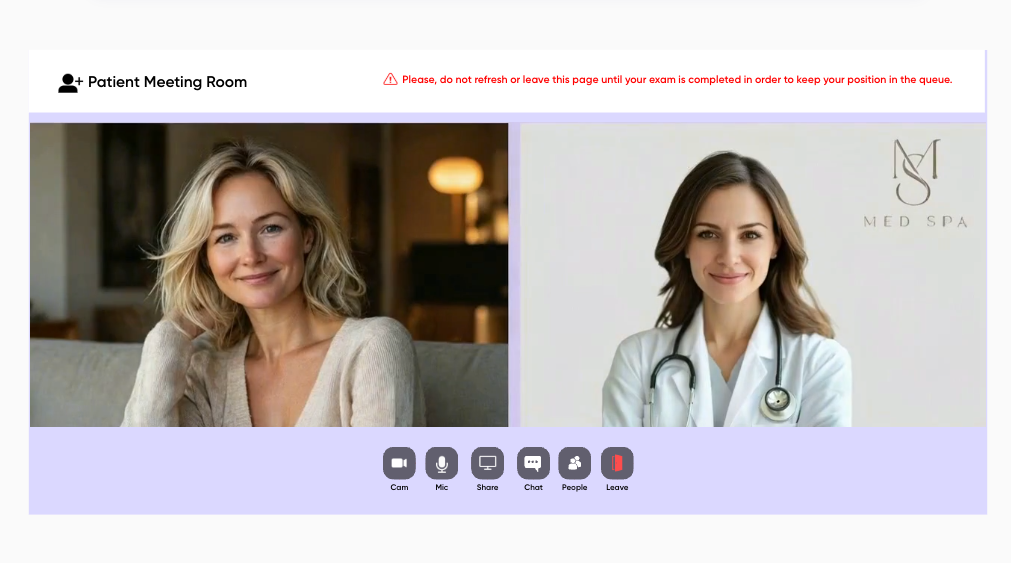
The patient taps a link and connects to a licensed provider in their state, on average in about seventeen seconds. There is no appointment to book and no calendar to coordinate — they connect to a locally licensed provider that is available at that exact moment.
The patient completes intake and submits what the protocol requires. A licensed provider reviews the submission, makes the clinical decision and returns a written order — without the patient sitting and waiting for a video window to open.
A patient who arrives at 10 p.m. doesn't hit a closed door. Asynchronous workflows keep them moving until a provider picks the case up, instead of asking them to come back tomorrow.
Whether a given treatment can be handled asynchronously depends on the state and the treatment. The platform lets you configure that per encounter type so the right mode is enforced rather than chosen ad hoc at the front desk.
Both modes produce the same documentation: provider identity and license, intake responses, the decision and its rationale, timestamped, with declinations recorded like approvals.
Whether an encounter may be conducted asynchronously depends on the treatment and on the state in which the patient is located, and those requirements change. Qualiphy provides both modes and the documentation behind them; which one applies to a given service is a decision for your practice and your medical director.
The gap
Buying telehealth software looks like a software decision. It isn't. The interface is the easy part, and every vendor has solved it.
The hard part sits behind it: licensed providers in every state you serve, coverage during every hour you operate, audit-ready documentation, and a clinical team accountable when a patient needs care at 7 p.m. on a Saturday. Skinned software leaves all of that to you — which is how a ten-minute purchase becomes a six-to-twelve-month build.
A branded video window still needs a clinician on the other end. You recruit, credential and schedule them yourself — for every state you serve and every hour you're open.
Each state requires providers licensed in that state. Opening a second location turns into months of paperwork before a single patient is seen there.
In-house coverage means paying for hours nobody books, and turning away the walk-in who shows up outside them.
A telehealth encounter is only as good as the trail it leaves. Building that correctly — provider identity, license, decision, rationale, timestamp — is its own engineering project.
Most practices don't want to become a telehealth company. They want telehealth to work, under their own brand, at the flip of a switch.
Build vs. buy
White label telehealth software gives you a branded video window. A telehealth vendor gives you a branded video window and an invoice. A fully managed white label platform gives you licensed providers, multi-state coverage, both visit modes, EMR-integrated documentation, and a workflow your front desk can run on day one.
| Build in-house | White label software only | Staffing / locum providers | Qualiphy — fully managed | |
|---|---|---|---|---|
| Time to launch | 6–12 months | Weeks, then you staff it | Months per state | About 10 minutes |
| Licensed providers included | You recruit them | No — bring your own | You contract each one | 1000+ providers included |
| Multi-state licensure | You manage it | You manage it | One license per provider | 48 states + D.C., handled |
| Runs under your brand | If you build it | Logo swap, often vendor-branded flow | n/a | White label end to end |
| Sync and async modes | You build both | Often one or the other | Live only | Both, per encounter type |
| Engineering required | Full product team | Integration work | None | None — includes API integration |
| Cost when nobody books | Salaries + hosting | Monthly platform fee | Retainers | $0 — pay per encounter |
| Evening & weekend coverage | You staff it | You staff it | Premium rates | Included, 7 days a week |
| Documentation & records | You build it | You configure it | Manual | Automatic on every encounter |
| Who owns the patient relationship | You | You | You | You — always |
Fully managed means the providers come with the software — not just the interface around them.
The platform
Your patients should never learn our name. The white label platform runs inside the booking flow, website and records system you already own — with or without a line of code.

Patients connect from your site, your records system or your booking page. The visit happens inside your brand, never a separate portal.
Trigger encounters programmatically from your own stack and pull results, written orders and documentation back automatically. Entirely optional.
Providers, routing, licensure, documentation and Rx dispatch are operated for you. Nothing to staff, nothing to maintain.
Documentation lands in your record without anybody re-typing it, through direct integrations or the API.
Run live video, store-and-forward, or both — the workflow follows the treatment and the state, not the vendor's preference.
Configure the intake questions, exam types and protocols your practice actually uses, to match what your medical director requires.
How it works
Roughly ten minutes to set your practice up. Seventeen seconds, on average, to connect a patient to a licensed provider in their state. The sequence below is the synchronous path; the asynchronous path splits after step two.
Your team opens the patient and selects the encounter type. One click sends a link carrying your brand.
No app · No passwordMedical history, current medications, reason for visit, state confirmed.
~2 minutesThe platform finds a provider licensed in that patient's state and free at that moment. No scheduling step.
17s averageA physician, NP or PA — license verified at visit time — sees your patient in your branded flow.
Synchronous modeThe record lands in the chart before the patient leaves. Any prescription dispatches within the hour.
<1hr Rx dispatchWhat you can run on it
Good Faith Exams are the most common reason practices sign up, but they are one part of what the software supports. The same account, the same branding and the same provider network cover the rest — at no additional platform cost.



On-demand GFEs before injectables, IV therapy, GLP-1s and peptides — with a written patient-specific order, not just a clearance note.
Written orders from a licensed provider, filed against the patient record and available to your medical director.
Prescriptions dispatched within the hour, shipped to the patient's home or routed to their pharmacy.
Order lab work and at-home test kits inside the same workflow, with results returning to the same record.
For treatments and states where a live visit isn't required, and for volume that arrives after hours.
Build the exam and intake types your protocols and your medical director actually require.
The provider network
The fair question every operator asks before putting another company's providers in front of their patients under their own brand. Here is the whole answer.

Family medicine · Licensed in 46 states
A family medicine physician, healthcare entrepreneur and medical executive with extensive experience in telemedicine, medical weight management, aesthetics and IV therapy. He serves as Chief Medical Officer of The GLO Network and provides medical leadership across multiple healthcare organizations.

Board-certified emergency medicine
A board-certified emergency physician and osteopathic medicine specialist. A graduate of Nova Southeastern University College of Osteopathic Medicine, he trained at Jackson Memorial and Mount Sinai in Miami and served as an ER physician, flight surgeon and Emergency Department director during his U.S. Army service.
1000+ licensed advanced practice providers — physicians, nurse practitioners and physician assistants. Not scribes, not coordinators.
Every patient is routed to a provider licensed in that patient's state at the moment of the encounter, across 48 states and D.C.
No scheduling step and no single provider to depend on. The network absorbs walk-ins, weekend volume and seasonal spikes without you staffing for peak.
Provider decisions are documented on every encounter — identity, license, content and rationale — reviewable by your practice and your medical director.
Non-routine cases are declined or escalated rather than rubber-stamped, and a declination is documented with the same rigor as an approval.
Providers introduce themselves as working on behalf of your practice. The clinical capacity is ours; the relationship stays yours.
Compliance
The difference between telehealth software and a telehealth partner is what exists after the encounter ends — in either visit mode.
Not a clearance checkbox. The distinction most state boards actually care about.
Verified at the time of the encounter, not assumed from a roster.
Provider identity, license, encounter content, decision and rationale, on every visit.
A declined patient becomes a defensible record instead of a gap in the chart.
Records are available to your practice, so your medical director can review provider decisions without sitting in on every visit.
Pull any encounter record on demand for an audit, a board request or a malpractice inquiry.
Requirements vary by state and by treatment. Qualiphy provides the encounter, the licensed provider and the documentation; your practice remains responsible for its own scope, licensure and standard of care.
Who it's for
Any business whose customers already care how they look, feel, recover, perform and age is one clinical layer away from a new revenue line. Qualiphy supplies the licensed providers, so adding that layer doesn't mean hiring one.
Add a branded virtual care layer without hiring a nurse practitioner for every open hour. Clear injectables, IV therapy, GLP-1s and peptides the moment the patient is ready.
On-demand licensed coverage across the whole treatment menu, with written orders and documentation on every encounter, all under your own name.
Hormone therapy, IV, weight management and longevity protocols — live or asynchronous, same provider network, same records.
Your patients already come to you about recovery, mobility and pain. Weight management, peptide protocols, IV therapy and lab panels sit naturally alongside that work — and with a licensed provider network behind the exam, you can offer them without adding a prescriber to payroll.
Members are already paying you to help them look, feel and perform better. GLP-1 programs, peptides, prescription wellness plans and at-home lab testing turn that relationship into a recurring clinical revenue line, delivered under your own brand rather than a referral out the door.
One telehealth system across every location, with nationwide provider coverage instead of rebuilding a clinical bench in each new market.
What operators say
“As a medical spa owner, Qualiphy has been an amazing strategic partner that has added tremendous value for us. Highly recommend!”
“We've had a great experience working with Qualiphy. The platform is easy to use, the providers are professional and informative, and the turnaround time has been excellent! Highly recommend Qualiphy to any clinic looking for a reliable telemedicine partner.”
“I'm a nurse and I have been using Qualiphy to see my patients before their visits… The process is smooth and simple, the providers are knowledgeable and always so friendly… help me present a good image to my business!! This has made my job so easy.”
“Love Qualiphy! It's fast and I'm able to get clients seen same day. I suggest this to every clinic that need GFE exams. Very efficient.”
“Game changer for my practice.”
“Amazing as usual.”
Pricing
Flat rate per completed encounter, starting at $27.99 for a good faith exam. Same price structure whether the encounter is synchronous or asynchronous. You decide what the patient pays.
Qualiphy invoices you. Your patient never sees our price, a charge from us, or a second checkout.
Charge what you like, or fold it into the treatment price. The encounter becomes a margin line, not a cost line.
A no-show, an abandoned link or a patient who changes their mind costs you nothing.
No subscription, no minimums, no annual contract. Cancel anytime.
FAQs
Book a demo
A 30-minute walkthrough with a specialist: how encounters route to a licensed provider, how synchronous and asynchronous modes are configured, what white label and API options look like on your site, how documentation reaches your EMR, and what onboarding involves. Bring the states you operate in — we'll map your routing live.
No card, no annual contract · Setup takes about ten minutes · Licensed provider coverage in 48 states + D.C.