The Good Faith Exam vs Patient Specific Orders: What Is the Difference and Why Does It Matter?
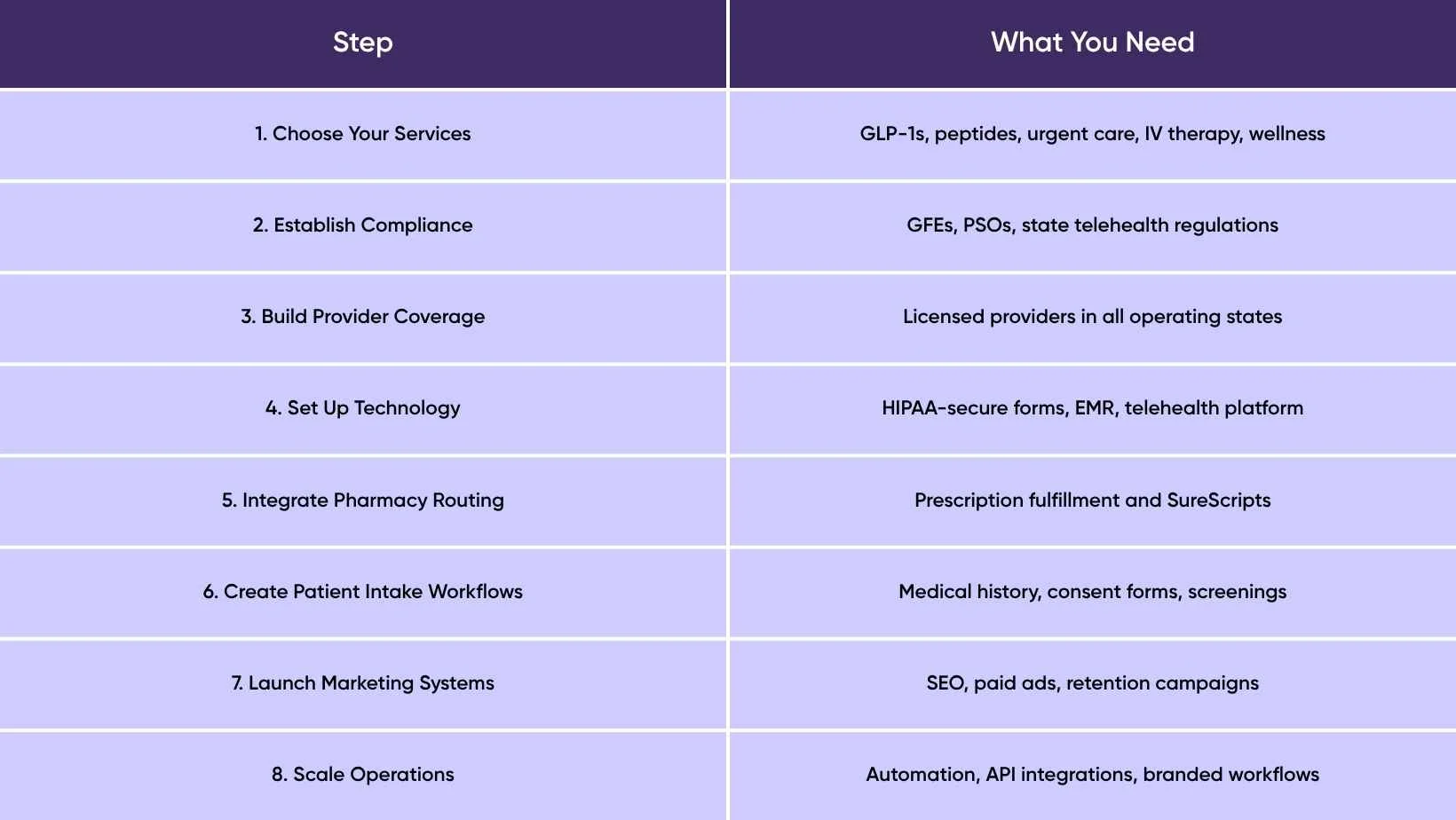
How Do You Start a Telehealth Business?
To start a telehealth business, clinics need a compliant provider network, HIPAA-secure technology, patient intake workflows, state-specific medical compliance, pharmacy routing, and telemedicine infrastructure that supports virtual consultations. Many aesthetic and wellness clinics now use white-labeled telemedicine solutions to launch faster without hiring internal providers.
As the medical aesthetics and wellness industries increasingly adopt telemedicine, navigating the legal landscape becomes essential for clinic owners and medical directors. Two terms that often surface—Good Faith Exam (GFE) and Patient Specific Orders (PSOs)—are frequently misunderstood or used interchangeably. However, understanding the distinct regulatory and operational differences between these two is critical for compliance, risk management, and scalability.
In this article, we will break down the legal definitions, compliance requirements, and real-world implications of Good Faith Exams and Patient Specific Orders. We will also explore how solutions like Qualiphy enable fully compliant, nationwide telemedicine implementation for med spas, aesthetic clinics, and wellness providers.
What Is a Good Faith Exam (GFE)?
A Good Faith Exam is a mandatory medical evaluation conducted by a licensed provider before prescribing medications or performing specific medical procedures. The term originated from legal statutes requiring that medical treatment must be based on a proper assessment of the patient’s health status.
Legal Requirements of GFEs:
- Must be performed by a licensed provider (MD, DO, NP, or PA)
- Can be conducted in-person or via telemedicine depending on the state
- Includes an evaluation of patient history, current symptoms, and suitability for treatment
- Is required before delegating medical procedures or prescribing medications
At Qualiphy, all Good Faith Exams (GFEs) are built with state-by-state compliance in mind, supporting both synchronous (live video) and asynchronous (form-based) modalities across all 50 states. Clinics can access instant Good Faith Exams for treatments like Botox, GLP-1 prescriptions, peptides, and more—with clearance stored securely in an EMR or in the Qualiphy portal.
What Is a Patient Specific Order (PSO)?
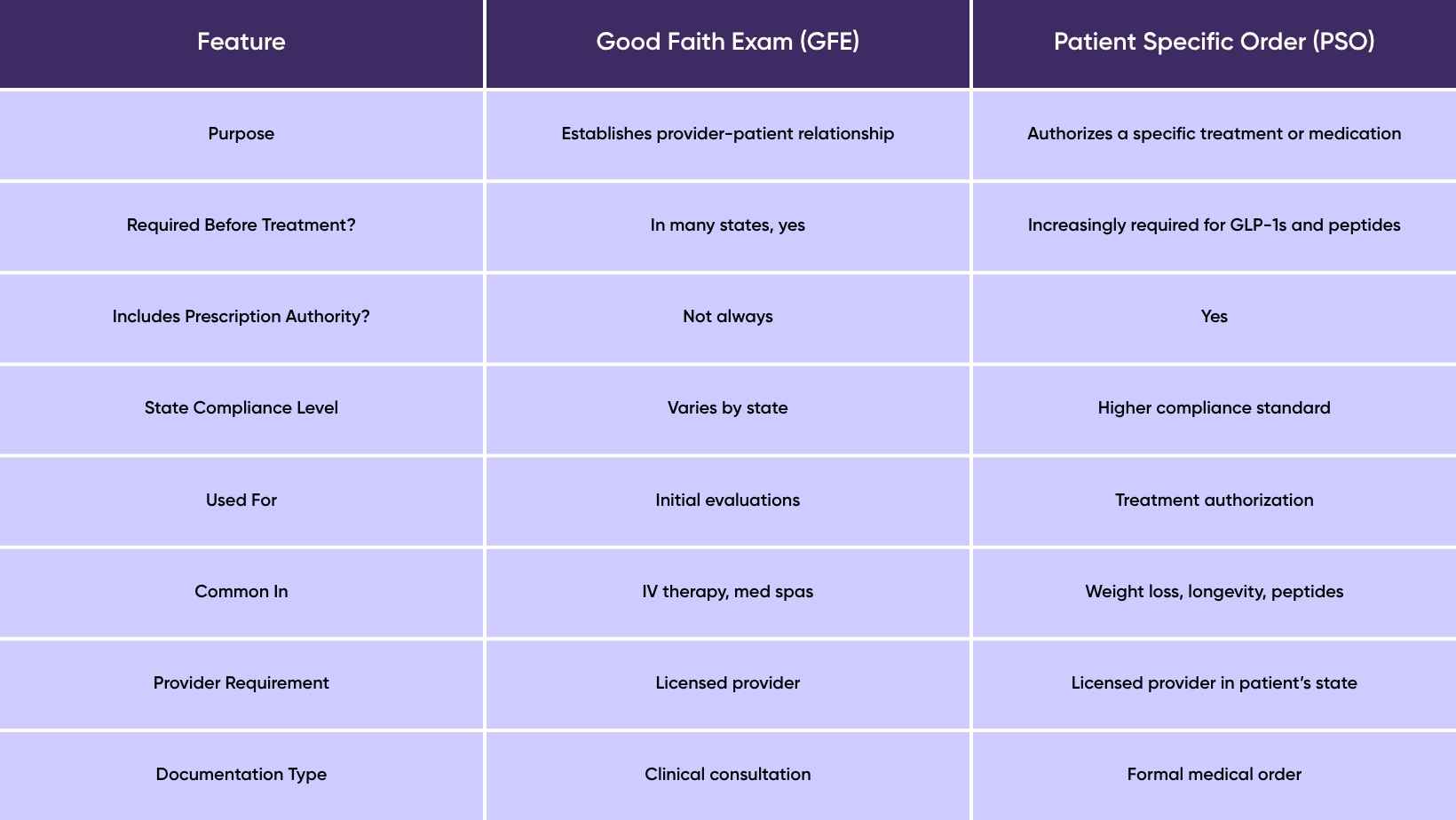
A Patient Specific Order (also called a Patient Specific Prescription or Protocol) refers to a directive written by a licensed provider for a specific patient, authorizing a medication or medical service. Unlike a GFE, which is a prerequisite evaluation, a PSO is the next step in the clinical pathway—authorizing the treatment plan or medication based on the evaluation.
PSO Requirements:
- Must follow a prior Good Faith Exam or physician assessment
- Includes specifics of the medication or therapy (e.g., dose, duration, formulation)
- Often required for pharmacies to legally dispense compounded medications
- Must be stored and accessible for auditing and regulatory review
In many states, GLP-1s like compounded Semaglutide or Tirzepatide require a PSO before pharmacy fulfillment can occur. Platforms like Qualiphy streamline this process with built-in telemedicine protocols, provider-issued PSOs, and direct pharmacy integration.
Good Faith Exam vs Patient Specific Order: Key Differences
As regulations evolve, many aesthetic and wellness clinics are discovering that a Good Faith Exam alone may not satisfy state telehealth or pharmacy requirements. A Patient Specific Order (PSO) provides a stronger compliance framework by linking a licensed provider directly to the patient’s prescribed treatment. This is especially important for clinics offering GLP-1 medications, peptide therapies, and compounded prescriptions.
Why Understanding the Difference Matters
1. Compliance Risk Mitigation
Incorrectly replacing a GFE with a standing order or protocol can lead to serious violations:
- DEA investigations
- Medical board discipline
- Fines or license revocations
By using a telemedicine provider like Qualiphy that offers both compliant GFEs and automated PSO issuance, clinics protect themselves from legal exposure.
2. Scalability
With laws varying state by state, it’s impossible to expand without scalable compliance systems. Qualiphy allows med spas to offer GLP-1s, peptides, and cosmetic procedures nationwide without hiring providers in every state.
3. Operational Efficiency
Separating GFEs from PSOs and automating them through a unified portal:
- Eliminates back-and-forth emails
- Speeds up time-to-treatment
- Creates a reliable audit trail
The Role of Telemedicine in GFEs and PSOs
The growing acceptance of telemedicine has significantly shifted how GFEs and PSOs are conducted. Many states now permit:
- Asynchronous GFEs via form-based platforms
- Electronic PSO transmission directly to pharmacies
Qualiphy’s telehealth infrastructure is optimized for this environment:
- Providers available 7 days a week, 6 AM–7 PM PST
- Nationwide coverage with licensed providers
- No subscriptions—$27.99 per GFE, $49.99 urgent care consults, fully white-labeled
Explore Qualiphy’s full list of available GFEs including:
- Botox and Neuromodulators
- Compounded Semaglutide and Tirzepatide
- Peptides: NAD+, Glutathione, Sermorelin, PT 141
- Radiofrequency and Laser Treatments
Real-World Example: GLP-1 Compliance
Let’s walk through an example of compounded Semaglutide, a popular GLP-1 medication for weight management.
What’s Required?
- A Good Faith Exam to determine patient suitability
- A Patient Specific Order outlining the prescribed dose and treatment plan
- Fulfillment through a licensed compounding pharmacy
What Happens If You Skip Step 1?
The prescriber and clinic may be charged with “prescribing without examination”—a major violation in most states.
Qualiphy solves this entire workflow:
- Instant GFE with documentation
- Issued PSO sent to pharmacy
- Fulfillment + nationwide shipping
- Fully auditable and compliant
What to Look for in a Telemedicine Partner
Not all platforms offering GFEs or telemedicine comply with state-specific PSO rules. Key indicators of a compliant partner include:
- Nationwide licensed provider network
- Built-in asynchronous and synchronous support
- Integrated EMR/API and white-label branding
- Transparent pricing with no setup fees
Unlike WeTreat or GFease, Qualiphy integrates both GFEs and PSOs under one compliant, white-labeled workflow with no subscription fees—allowing your clinic to scale without hiring in-house staff or increasing chair time.


 Qualiphy (PSO + GFE)
 GFE Clearance Only
 Often missing or left to client/provider, risking fulfillment issues